
The Big Question Everyone Is Asking
Let’s address the elephant in the room.
Is AI going to replace virtual assistants?
It’s a fair question. Everywhere you look, there’s another headline screaming about automation, machine learning, and AI tools “taking over jobs.” If you run a business or work remotely, it can feel like the ground is shifting beneath your feet.

But here’s the reality most articles gloss over:
This isn’t a war. It’s a workflow redesign.
The real conversation isn’t about replacement. It’s about how AI and virtual assistants fit together.
Understanding Artificial Intelligence in Business
Before we compare anything, let’s clear up what AI actually is in a business context.
AI isn’t some sci-fi robot sitting in your office. It’s software trained to process patterns, predict outcomes, and automate decisions based on data.
What AI Actually Does Well
AI is exceptional at things humans find boring, slow, or overwhelming.
Think:
- Processing huge amounts of data
- Automating repetitive tasks
- Identifying patterns across systems
- Running 24/7 without fatigue
AI doesn’t get tired. It doesn’t procrastinate. It doesn’t need coffee breaks.
For structured, rule-based tasks, AI is brutally efficient.
Where AI Still Struggles
Now the uncomfortable truth.
AI still lacks genuine understanding.
Yes, it can simulate conversation. Yes, it can generate text. But nuance, context, emotional sensitivity, and unpredictable human behavior? That’s where cracks appear.
AI doesn’t “understand” frustration in a client’s voice.
AI doesn’t read between the lines of vague instructions.
AI doesn’t instinctively know when a situation requires flexibility instead of logic.
And that matters more than people admit.
What a Virtual Assistant Really Brings to the Table
Virtual assistants are often reduced to “task executors.” That’s an oversimplification.
A skilled VA isn’t just checking boxes — they’re interpreting, prioritizing, adapting.
Human Judgment and Context
Businesses are messy.
Instructions change. Clients contradict themselves. Priorities shift mid-day.
A VA navigates ambiguity.
They don’t just follow commands — they make sense of incomplete information.
That ability alone is incredibly hard to automate.
Emotional Intelligence and Communication
Communication isn’t just about words.
Tone, timing, empathy, persuasion — these are human skills.
When dealing with clients, partners, vendors, or internal teams, emotional intelligence often determines outcomes more than raw efficiency.
AI can assist communication.
Virtual assistants manage relationships.
There’s a difference.
The Myth of “AI Will Replace Everyone”
Let’s be blunt.
“AI will replace humans” is a lazy narrative.
Technology historically eliminates specific tasks, not entire roles.
Calculators didn’t eliminate accountants.
Email didn’t eliminate administrators.
Spreadsheets didn’t eliminate financial analysts.
AI follows the same pattern.
It reshapes work. It doesn’t erase the need for human involvement.
AI vs Virtual Assistants: Key Differences That Matter
Why This Isn’t a Battle — It’s a Partnership
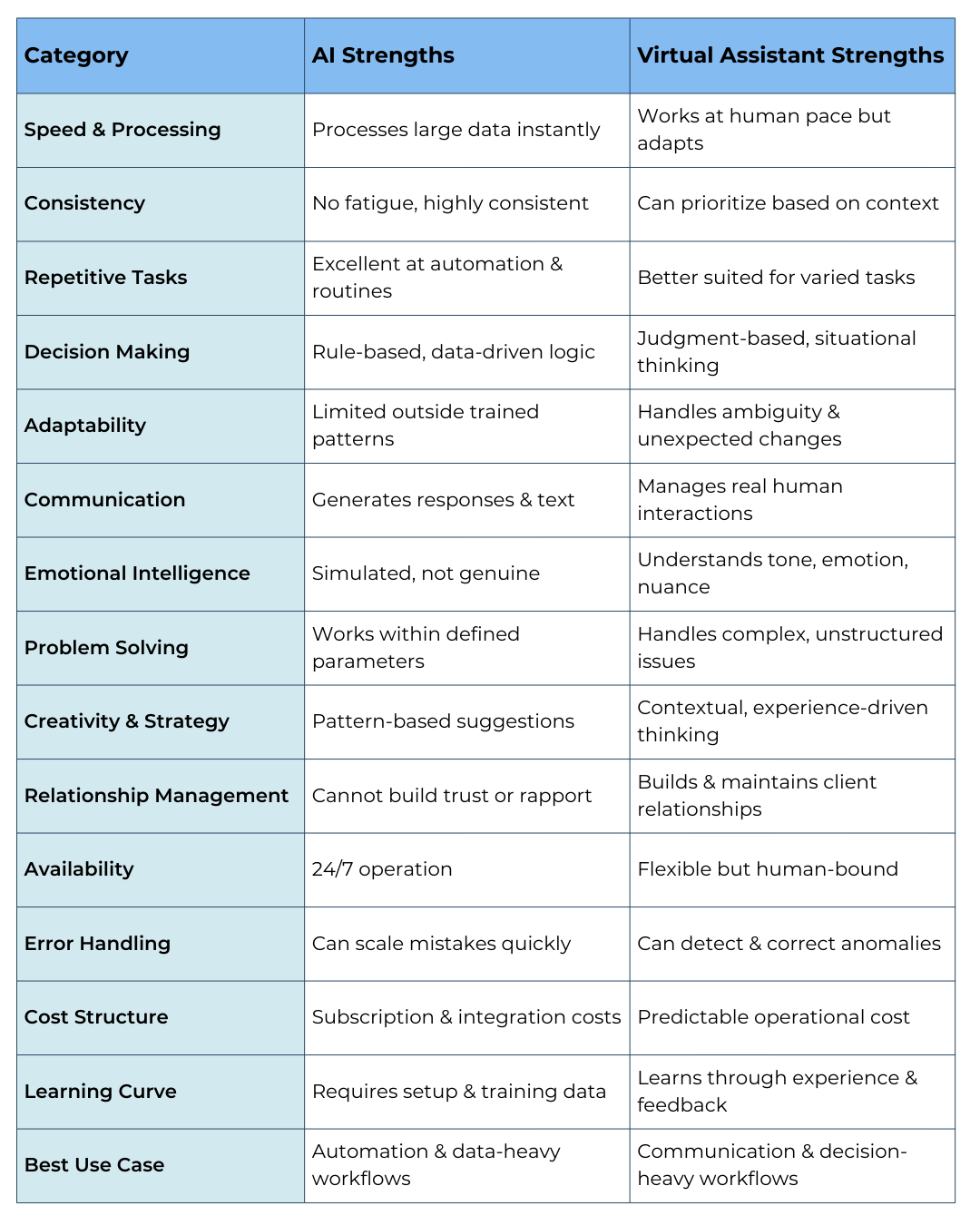
Why Businesses Are Moving Toward Hybrid Models
Smart companies aren’t choosing between AI and humans.
They’re combining both.
Why?
Because efficiency without judgment is dangerous, and judgment without efficiency is expensive.
Hybrid systems balance both.
Tasks AI Can Handle Better Than Humans
Let’s give AI its credit.
Data Processing and Analysis
AI thrives on structured data.
Reporting, analytics, trend detection — this is AI territory.
A VA manually analyzing thousands of entries? Slow and error-prone.
AI? Instant.
Repetitive Administrative Work
Scheduling, tagging, categorizing, basic automation — AI handles repetition flawlessly.
Humans shouldn’t waste cognitive energy on tasks machines excel at.
Tasks Virtual Assistants Still Dominate
Despite AI’s strengths, humans remain essential.
Client Communication
Real conversations require emotional sensitivity, persuasion, and situational awareness.
Clients don’t always behave logically.
They behave… humanly.
Complex Decision-Based Tasks
Anything involving judgment, interpretation, negotiation, or strategic thinking still heavily favors human involvement.
AI assists.
Humans decide.
The Power of Collaboration: AI plus Virtual Assistants
Here’s where things get interesting.
When AI and VAs work together, productivity can multiply rather than merely improve.
Imagine:
AI handles data, automation, and repetitive workflows.
Virtual assistants handle communication, decision-making, coordination, and client interaction.
That’s not replacement.
That’s amplification.
Real-World Business Scenarios
Let’s ground this in reality.
Marketing and Lead Generation
AI can analyze audience data, automate campaigns, and generate insights.
But messaging strategy, creative direction, client management, and relationship-building? Human territory.
Operations and Project Coordination
AI can track metrics and automate updates.
VAs manage people, deadlines, exceptions, and evolving priorities.
Projects are rarely linear.
Humans navigate non-linearity better.
Cost Efficiency: AI Alone vs Human Support
This is where many businesses miscalculate.
AI tools have costs — subscriptions, integration, maintenance, training.
They’re not “free employees.”
And poorly implemented AI can create expensive inefficiencies.
Virtual assistants, when paired with AI, often deliver higher ROI because they ensure systems actually work as intended.
Productivity Gains from Smart Integration
The magic isn’t AI.
The magic is system design.
Businesses that strategically combine automation with human oversight consistently outperform those chasing “full automation.”
The Future of Work: Evolution, Not Elimination
Jobs don’t disappear overnight.
They evolve.
Virtual assistants aren’t becoming obsolete.
They’re becoming more strategic.
Less task-focused.
More decision-focused.
More systems-focused.
How Businesses Should Think About AI Adoption
Instead of asking:
“Will AI replace my VA?”
Ask:
“How can AI enhance my VA’s effectiveness?”
That mindset shift alone can dramatically change outcomes.
Final Thoughts
AI isn’t the enemy of virtual assistants.
It’s their most powerful tool.
Businesses that frame this as replacement often end up with rigid systems, communication gaps, and hidden inefficiencies.
Businesses that frame this as collaboration gain speed, flexibility, and resilience.
Technology works best when it complements human intelligence — not when it attempts to imitate it blindly.
FAQs
1. Will AI completely replace virtual assistants in the future?
Highly unlikely. AI eliminates tasks, not the need for human judgment and communication.
2. What tasks should businesses automate with AI?
Repetitive, structured, and data-heavy tasks are ideal candidates.
3. Where do virtual assistants remain essential?
Client communication, decision-making, coordination, and strategic support.
4. Is using AI more cost-effective than hiring a VA?
Not always. Poor AI implementation can be expensive. Hybrid models often yield better ROI.
5. What is the smartest approach for businesses today?
Combine AI efficiency with human adaptability.